

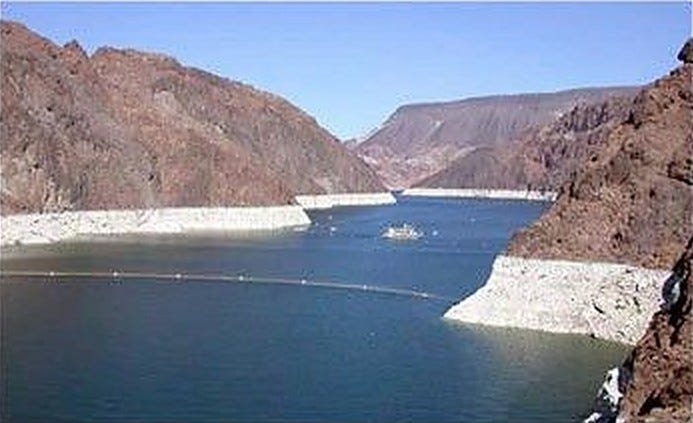
The thick white band ringing Lake Mead’s shoreline marks how far the water has dropped. Photo courtesy National Park Service, Lake Mead National Recreation Area.
Amazon wants to help save the Colorado River.
That is a good thing. But is it enough?
The company has announced a $20 million investment in water-conservation projects across the Colorado River Basin and is helping launch a corporate coalition with a two-year goal of mobilizing $100 million. One Arizona project will invest $2.4 million toward irrigation-efficiency technology on tribal farmland in the Lower Colorado River Basin. Amazon says the project is expected to save approximately 238 million gallons of water each year.
Amazon is not alone.
Intel says it has funded 20 water-restoration projects benefiting Arizona that, when fully implemented, are expected to restore almost 2.2 billion gallons annually.
Microsoft reports investments in Arizona irrigation modernization and AI-enabled technology to detect hidden leaks in aging water systems. In the greater Phoenix area and nearby Nevada communities, Microsoft and local utilities are using acoustic sensors to find leaks before they become larger losses. It’s a simple idea with significant potential: water saved by fixing what is already leaking is water that does not have to be found somewhere else.
The new Colorado River Basin Collaborative includes companies and organizations including Amazon, Aldi, the Coca-Cola Foundation, Ecolab, EdgeConneX, Grundfos, Vantage and Xylem. Participants have committed $32 million toward the coalition’s $100 million two-year objective.
So, something important is happening. Corporate America is beginning to recognize that water is not simply an environmental issue. It is an economic issue and, increasingly, a business-risk issue.
Thus, the emergence of water-based philanthropy.
Companies understand that their relationships with communities, employees, customers and investors matter. Increasingly, they also understand that the natural resources on which their businesses depend matter.
That makes their investments welcome, but it also raises a complicated question: What happens when corporate philanthropy is a response to a problem that is fundamentally larger than philanthropy?
Amazon puts the question in perspective. The company says the Colorado River Basin serves nearly 40 million people, 5.5 million acres of farmland and 30 tribal nations. After 25 years of severe drought, the basin’s two largest reservoirs are below 30% capacity, and the gap between supply and demand is roughly 1 trillion gallons per year.
Amazon’s Arizona project could save about 238 million gallons annually. That’s real water, but it’s also a tiny fraction of the basin’s estimated annual supply-demand gap.
The Colorado River does not have a $20 million problem. It does not have a $100 million problem. It has a structural problem involving water supply, demand, agriculture, cities, tribal water rights, infrastructure, population growth, climate variability and decades of decisions about how the river’s water would be allocated.
No corporation can solve that problem with a check. The more interesting question is whether corporate philanthropy can become something more than philanthropy.
Corporate water philanthropy doesn’t tell us how much water the company uses, how its supply chain consumes water, how future expansion will affect local water systems or whether its own operations are increasing demand for the resource it is helping conserve.
Those are questions of accountability, and they should apply to every corporation operating in a water-stressed region. In that regard, there’s another question: What is the relationship between the company’s business model and the problem it is trying to help solve?
The response should not be whether a corporation looks like a good citizen. The standard should be whether its actions actually help make Arizona more water-secure. That means measuring results: How many gallons are actually conserved—not merely how much money is announced? Is the water permanently conserved, or simply shifted from one use to another? Can successful projects be replicated? And what happens to the conservation gains when the company itself grows?
Arizona needs more than corporate philanthropy. It needs corporate responsibility aligned with public policy, technological innovation, agricultural adaptation, infrastructure investment and sustained conservation working together.
Water-based philanthropy may be a beginning. Arizona needs to make sure it doesn’t become the end of the conversation…or the end of conservation.
What my many years of experience has taught me is that we need to be wary of corporate philanthropy. I'm certainly not throwing the baby out with the bath water in this instance; however, I am skeptical and hope all the "devils in the details" are brought to light and vetted.
Thank you for your post, Herb.
I live in the Coachella Valley, just outside Palm Springs, in Rancho Mirage. We depend on water from the Colorado River, as well as groundwater pumped from the aquifer beneath the valley.
The Coachella Valley aquifer has experienced significant declines in groundwater levels, largely because of heavy pumping to meet the demands of a growing population and the extensive number of golf courses that require regular irrigation. It is unbelievable to see waterfalls and fountains flowing as though our water supply will never run out.
An investigative analysis found that groundwater levels in parts of the aquifer declined by an average of 55 feet between 1970 and 2013. In some hard-hit areas, including La Quinta and Palm Desert, not far from where I live, excessive groundwater pumping has also contributed to land subsidence, with the ground sinking by as much as 1.5 to 1.8 inches per year.
Some estimates suggest that, at current rates of use, the aquifer could continue supplying water for at least another 100 years. However, that is an optimistic projection, particularly if demand continues to increase. Our population is growing, and now we face the prospect of AI data centers wanting to establish operations in the area, attracted in part by the availability of solar energy. These facilities could add substantially to our energy and water demands, depending on their cooling systems and how they are designed. That could place additional pressure on our groundwater resources and complicate our efforts to manage our Colorado River water allocation.
What concerns me is that there does not appear to be enough public discussion about the long-term consequences of these competing demands or about what we should be doing now to address them.
I’m not sure how the concept of corporate water philanthropy could get off the ground here, or how much impact it would have, given our relatively limited industrial base. However, if AI data centers begin moving into the Coachella Valley, perhaps we should consider requiring them to contribute meaningfully to local water conservation and replenishment efforts.
One possibility would be to structure such contributions through a special tax, development fee, or mandatory water-replenishment program tied to the facilities’ water consumption. Companies that profit from establishing energy-intensive operations in our region should also help pay for protecting the natural resources on which our communities depend.
We need to think about these issues before the problem becomes a crisis, rather than waiting until we discover that the water we have taken for granted is no longer sufficient to meet our needs.