

I don’t usually build a column around another writer’s work. My focus in THE CENTER LANE has regularly been the slow erosion of small-d democratic norms by technocrats who think governance is just a systems-design problem, oligopolists who mistake market power for a mandate to rule, and anti-constitutionalists who see checks and balances as impediments to their political control.
But every so often someone else’s reporting is so sharply on point and alarming that it demands to be brought into the conversation. That’s the case with journalist Gil Duran and the project he calls The Nerd Reich.
Duran isn’t a fringe commentator. He spent fifteen years in California politics as a strategist and spokesman for Dianne Feinstein, Jerry Brown, and Kamala Harris before returning to journalism, eventually running the opinion pages at the Sacramento Bee and the San Francisco Examiner. For the past two-plus years he’s used his newsletter, a chronicle of what he calls “tech fascism,” to track a strain of Silicon Valley politics that has moved to the West Wing.
His new book, The Nerd Reich: Silicon Valley Fascism and the War on Democracy, lands this month from Simon & Schuster, and it pulls together years of reporting into a single, unsettling thesis: a small circle of extraordinarily wealthy tech figures has concluded that democracy itself is an obstacle, and they’ve spent three decades building the intellectual framework and now the political muscle to upend it.
Duran traces the movement’s origin story back to a 1997 book entitled The Sovereign Individual, written by two conservative economic commentators, James Dale Davidson, founder of the National Taxpayers Union, and Lord William Rees-Mogg, editor-in-chief of The Times. The book predicted that digital technology and cryptocurrency would eventually let a “cognitive elite” of wealthy entrepreneurs break free of the taxes, regulations, and democratic process of nation-states. The authors found champions of their argument in Peter Thiel and a generation of tech figures including Curtis Yarvin and Balaji Srinivasan.
Thiel, the co-founder of PayPal and Palantir Technologies, declared his contrarian perspectives in works, including Zero to One, in which he argues that true economic progress comes from building monopolies; The Diversity Myth in which he critiques multiculturalism and political correctness; and The Education of a Libertarian in which he expresses his skepticism about the compatibility of democracy and freedom.
Yarvin was a programmer who had blogged under the pseudonym “Mencius Moldbug” and argued that the United States should be run like a corporation and governed by a “CEO” wielding dictatorial authority rather than by elected officials. Srinivasan, a former Coinbase executive, published The Network State, a book that presents a roadmap for billionaires to build parallel “startup societies” outside the jurisdiction of existing governments. We’re seeing such real-world versions of these “sovereign” entities already underway, from the Próspera charter city in Honduras to the California Forever land project north of San Francisco.
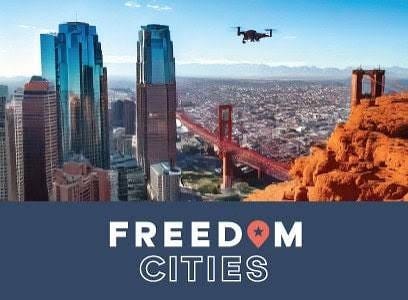
Conceptual rendering from the Charter Cities Institute’s 2025 report Freedom Cities: Accelerating American Innovation by Reducing Regulatory and Administrative Burdens
The idea has also found a foothold in Washington. Trump first floated “Freedom Cities” in the 2023 campaign, proposing up to ten new cities chartered on federal land and awarded through a “development contest.” Draft legislation would make them “federal enclaves” largely exempt from the tax code, environmental law, and federal labor protections, and governed by the developers who win the bid rather than by elected officials. Residents wouldn’t be able to vote in state elections. The financial backers are a who’s who of the technocrats that Duran writes about. Duran describes these as cities where the owners hold all the power and everyone else has none.
In this regard, Duran adopts a term coined by the economist Albert O. Hirschman, that captures the tension between the proponents of democracy and technocracy: voice and exit. In a functioning democracy, if you don’t like how things are run, you use your voice: you vote, organize, petition, and persuade. The nerd reich has given up on voice in favor of “exit,” preferring to leave the messy, slow, compromise-laden apparatus of democratic government behind entirely and founding something new that answers to no electorate at all. (Thiel has reportedly relocated to Argentina and Yarvin talks about moving.) It’s a philosophy that treats the fundamental promise of self-government, that legitimacy flows from the consent of the governed, as an inefficiency to be engineered away rather than a principle to be honored.
All told, this is a story about a very old impulse: the belief that a wealthy, self-selected few know better than the rest of us and should be in control…and it’s dressed up in the fancy language of disruption and innovation.
The reason Duran’s reporting matters, and why you should be concerned, is that these aren’t any longer fringe ideas. Duran documents how figures shaped by this worldview, characters like Thiel and Elon Musk, have attached themselves to political power, with Vice President JD Vance among the officials whose thinking is heavily influenced by Yarvin. To press the point, Duran uses the example of Musk’s approach to Twitter after his takeover: mass firings, disregard for existing legal and institutional norms, and a preference for unilateral command over deliberation. It’s all a preview of what Yarvin’s ideas look like when applied to real institutions.
The concern here is one I’ve hammered on for a long time: concentrated private power that answers to no electorate, dressed in the language of efficiency and progress, is an existential threat to self-government. Duran’s contribution is naming it precisely and tracing its lineage with real rigor from a 1997 libertarian manifesto to a former blogger’s fantasies of corporate dictatorship to actual influence inside the current administration.
Duran’s framing is provocative. Some may be inclined to dismiss it as conspiracy thinking. Readers on the right may reject the label and argue that lumping libertarian techno-optimism in with authoritarianism isn’t fair or accurate. Even so, Duran’s documentation seems carefully sourced and hard to ignore.
If you want to hear his case from the author’s mouth, I urge you to listen to his recent interview on Fresh Air: https://www.npr.org/2026/08/10/nx-s1-5925350/the-nerd-reich-tracks-the-unmasking-of-silicon-valleys-true-politics.
Whether you end up calling it fascism, oligarchy, or something else, Gil Duran has done the work of naming a real ideological current and tracing exactly how it moved from the margins to the center of American power. In a moment when so much of our political vocabulary feels inadequate to what’s actually happening, that’s a genuine contribution and exactly the kind of “threat to democracy” we need to heed.
***
Additional references
The Nerd Reich: Silicon Valley Fascism and the War on Democracy, by Gil Duran, is out August 18 from Avid Reader Press/Simon & Schuster.
Duran’s newsletter, also called The Nerd Reich, is available at https://www.thenerdreich.com/
‘If we don’t fight back, we don’t have a future’: the journalist taking on the ‘tech fascists’ of Silicon Valley - https://www.theguardian.com/lifeandstyle/2026/aug/05/journalist-taking-on-tech-fascists-silicon-valley
The Sovereign Individual: Mastering the Transition to the Information Age, James Dale Davidson, William Rees-Mogg - https://www.simonandschuster.com/books/The-Sovereign-Individual/James-Dale-Davidson/9780684832722
Curtis Yarvin’s brave new world: ‘We need a corporate dictatorship to replace a dying democracy’ - https://english.elpais.com/usa/2025-08-19/curtis-yarvins-brave-new-world-we-need-a-corporate-dictatorship-to-replace-a-dying-democracy.html
Peter Thiel’s writings
The essays, talks, and interviews of Peter Thiel - https://www.startuparchive.org/p/the-essays-talks-and-interviews-of-peter-thiel
Zero to One: Notes on Startups, or How to Build the Future - https://icrrd.com/public/media/01-11-2020-203418Zero%20to%20One.pdf
The Education of a Libertarian - https://www.cato-unbound.org/2009/04/13/peter-thiel/education-libertarian/
The Diversity Myth: Multiculturalism and Political Intolerance on Campus - https://www.amazon.com/Diversity-Myth-Multiculturalism-Political-Intolerance/dp/0945999763
The Network State: How To Start a New Country, Balaji Srinivasan - https://www.amazon.com/Network-State-How-Start-Country-ebook/dp/B09VPKZR3G and https://thenetworkstate.com/book/tns.pdf
‘Freedom Cities’ Push on Public Land Gains Viability Under Trump, Bloomberg Law, April 10, 2025 - https://news.bloomberglaw.com/environment-and-energy/freedom-cities-push-on-public-land-gains-viability-under-trump
Tax evading scoundrels that care nothing about this Country, and certainly not democracy,...only themselves, their money, and their self interest. Obviously, it goes much deeper than just this... which is scary as hell! Great piece Herb!
“More Everything Forever” hammered on this as well.
Exposed these clowns as megalomaniacs.